
Atmospheric horror — fog, abandoned corridors, slow creaking doors — is fundamentally different from psychological horror, and Seedance responds to that distinction if you make it explicit. Atmospheric horror works through location and texture: the abandoned hospital looks wrong, and the audience feels it. Psychological horror works through perception: reality is unreliable, the protagonist's senses are compromised, and the audience can't trust what it is watching. The dread is epistemic rather than environmental.
What that means for prompting is structural. Atmospheric horror prompts can specify lighting, location, and a threat. Psychological horror prompts need to specify the relationship between what the character perceives and what is actually happening — whether those diverge, when the audience realizes it, and how the camera encodes the character's deteriorating certainty. The five prompts below each solve that structural problem differently: a full reality collapse under an unexplained external system, a found-footage phone realism that makes a mirror monster feel documented rather than staged, a mundane device (a phone notification) that becomes the delivery mechanism for a time paradox, a 14-scene per-beat shot specification that builds dread through accumulation rather than escalation, and a pure environmental location horror that lets the infrastructure itself do the threatening with no monster required.
1. RESET — two-character mystery with unexplained reality collapse
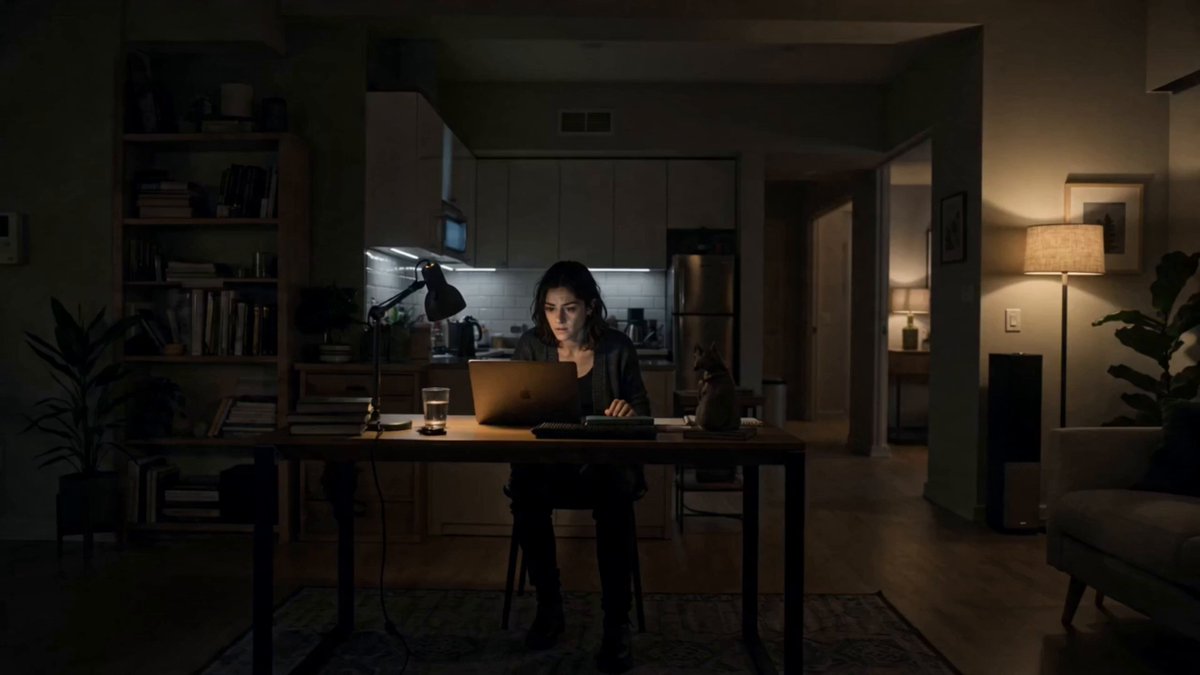
See the full prompt on scenic.sh →
"A woman sits alone at a desk, laptop open, dim room. Her fingers hover, hesitate, then type — stop — retype. Something's wrong and she can't name it."
Why this works: At 254 likes, this prompt demonstrates how to build a psychological mystery without resolving it. The core technique is the unexplained causal link: a man in a control room connects a drone, and a destroyed city instantly reverses — buildings settle, mushroom cloud folds in on itself, water falls back down — but why his system controls her reality is never stated. "The green light is the only clue — intentionally ambiguous, built for a sequel or fan theory." Mystery hooks operate by establishing a connection and withholding its explanation; the audience's attempt to construct the explanation is what holds attention.
The camera movement encodes the story arc mechanically: "creeping dolly-in (calm) → whip-cut to POV (shock) → low tracking follow (dread) → fast disorienting whip-pans/Dutch angles (chaos) → slow push-in (control/reveal) → smooth pull-back to stillness (resolution)." Each camera register corresponds to a story beat, and the movement itself tracks the protagonist's psychological state. During the chaos sequence, the prompt instructs rapid whip-pans with no stable frame — the camera is unhinged to match a world that has lost its rules. The restoration sequence returns to the slow, controlled pull-back that opened the film. Camera grammar as psychological map.
Takeaway: Build the mystery hook by establishing a causal connection between two characters without explaining it — the audience's attempt to close the loop creates sustained engagement that an explained mystery forecloses.
2. Late-night gym found-footage — mirror psychology and phone realism
See the full prompt on scenic.sh →
"Ultra-realistic old iPhone 1x standard lens, raw low-quality phone footage. While staring at her reflection, a strange dark human-like monster silhouette suddenly appears faintly behind her in the mirror."
Why this works: At 247 likes, this prompt's core technique is the authenticity transfer from the recording medium to the horror. "Old iPhone 1x standard lens, raw low-quality phone footage, heavy compression and constant digital noise" — these are not stylistic choices but a complete camera system specification. Old iPhone footage brings a bundle of associated artifacts: 1x focal length (no optical zoom, no telephoto compression), flat color science, visible compression blocking in dark areas, and the fundamental grain of a small sensor at low light. When a horror element appears inside footage that closely matches what real surveillance or personal recordings look like, the psychological register shifts — it reads as documented rather than staged.
The mirror is the structural pivot: the character sees the threat in her reflection before she sees it in the space, and when she turns, there is nothing. The threat exists in the mirror's image but not in the room — reality is split along the mirror plane. "She looks back at the mirror and the creature is still there, even closer" closes the logical circuit: if turning around reveals nothing, and the mirror still shows it, the mirror is not reflecting the room. The prompt explicitly restricts CGI: "the monster should remain subtle, dark and unsettling rather than an exaggerated CGI creature." Understatement is load-bearing in a realistic format — over-rendered monsters break the phone-footage contract.
Takeaway: Specify the recording device as a complete camera system (lens, sensor, compression artifacts) rather than a color grade — the medium's bundle of authentic artifacts makes horror elements read as documented, not staged.
3. "Video from: Me" — a mundane phone notification as time-paradox trigger
See the full prompt on scenic.sh →
"Phone notification appears showing 'Video from: Me'. On screen she sees herself — future version, more serious expression, subtle glitch. Future-her speaks silently. Text appears: 'Don't open that door'."
Why this works: At 134 likes, this prompt demonstrates the power of routing horror through the most mundane imaginable object — a phone notification. The delivery mechanism is completely familiar. A notification appears, she opens it, video plays. The break with reality is entirely contained inside the phone screen: the video is from her future self, and the future self is issuing a warning. Because the delivery mechanism is ordinary, the impossible content (a future self) produces dissonance that an overtly supernatural delivery (glowing portal, shadowed figure) would not — overtly supernatural setups tell you to expect the impossible; a phone notification does not.
The camera structure works by contrast: "cinematic lighting, soft blue tones" establishes a domestic, realistic register before the notification appears. After she opens the video, "tension rising" is followed by "suddenly loud knock on the door" — the warning from the future self arrives at precisely the moment the threatened door is tested. The time-paradox logic doesn't require explanation; the convergence of warning and knock is sufficient. "Dramatic zoom on her face" at that moment is the correct camera move — the character's reaction to convergence is the psychological horror.
Takeaway: Route the horror delivery through the most ordinary possible mechanism (a phone notification, an email, a voicemail) so the impossible content produces maximum dissonance — overtly supernatural delivery primes audiences for the impossible and reduces the shock.
4. The bedroom 02:47 arc — 14-scene per-beat shot specification
See the full prompt on scenic.sh →
"A digital alarm clock glows on a bedside table, its red display reading 02:47 inside a dimly lit bedroom… A tall, shadowy humanoid figure silently appears at the foot of the bed, motionless within the darkness."
Why this works: At 73 likes, this prompt builds dread through accumulation rather than escalation — the horror increases not because events get bigger, but because they get more specific and closer. The 14-scene breakdown assigns each scene its own camera type, lighting description, and event duration. Scene 1 is an extreme close-up of the alarm clock (02:47 — the hour itself is a horror convention activation). Scene 6 is "the lamp begins flickering violently before plunging the room into darkness. Moments later, the light abruptly returns." Scene 14 is a violent jump scare and screen cut to black.
The structure exploits a basic principle: the audience's dread state is set by how much they know relative to how much the character knows. By scene 3 ("close-up of her eyes widening as the lights flicker rapidly"), the audience sees what she sees and is in the same information state. Scene 6 — the return of light revealing "the alarm clock and stacks of books resting beside it" with the lamp off — is a false exhale: the room looks normal. Scene 9 ("she returns to bed, staring upward as a lingering sense of fear fills the room") establishes that she has decided it is over. Scene 11 introduces flicker again. Scene 14 delivers the figure. The audience's confidence in the false safety of Scene 9 makes Scene 14 effective; without the false exhale, it is just a jump scare.
Takeaway: Structure dread as a false-exhale sequence (threat → brief calm → worse threat) rather than a linear escalation — the audience's relaxation during the calm phase is what makes the subsequent threat land.
5. Abandoned hospital corridor — pure environmental dread without a monster
See the full prompt on scenic.sh →
"Cinematic horror scene, abandoned hospital at night, cold fluorescent lighting, wet reflective floor, peeling walls, rusted wheelchairs, distant metallic sounds. A tall shadow figure briefly appears under a blinking light at the end."
Why this works: At 23 likes this is the most formally restrained prompt in this set, and restraint is the point. The shot list has 7 beats: empty corridor with flickering lights; woman slowly backing away; close-up of her eyes widening; wheelchair moving slightly; shadow figure briefly at the far end; woman turning suddenly; corridor empty again, silence, one light still blinking. The monster never arrives. The shadow figure "briefly appears" at the far end, then is gone. The final shot is an empty corridor.
Psychological horror differs from slasher horror precisely in what it withholds. The monster's full appearance, a confrontation, an explanation of what is in the hospital — all of these are standard horror narrative conclusions. Withholding them forces the audience to construct the threat internally, and internal constructions are always scarier than rendered ones. "No comedy, no gore, hard cuts only" is a negative prompt that bans the stylistic registers most associated with horror entertainment rather than horror experience: gore signals genre; comedy signals distance; slow transitions signal craft over menace. Hard cuts between static shots give the empty corridor equal screen time to the woman, which means the corridor itself is the subject — the hospital's infrastructure is the threat.
Takeaway: Withhold the monster's full appearance in psychological horror — a brief, unresolved shadow appearance forces the audience to construct the threat internally, and internal constructions always exceed what can be rendered.
Psychological horror prompt cheat sheet
What these five Seedance prompts share:
- Perception gap as the core mechanism — in each prompt, what the character perceives and what is actually present diverge. RESET's character doesn't know her reality is controlled. The gym protagonist doesn't see the figure in the room. The phone-notification woman can't know her future self is warning her. The bedroom protagonist constructs safety in the false-exhale scene. The hospital corridor woman never knows what is at the end of the hall. The audience lives in the gap between character knowledge and actual threat.
- Camera grammar encodes psychological state — RESET maps each story beat to a distinct camera register (creeping dolly → whip-cut → tracking → disorienting angles). The gym's old-iPhone realism makes the threat feel documented. The bedroom's extreme close-ups on props (clock face, flickering lamp) tell the audience what to watch before the protagonist does. Camera grammar is not decoration; it is the mechanism by which the audience's psychological state is managed.
- Restraint over spectacle — none of these prompts resolve with a full monster reveal, an explained supernatural cause, or an escalating action sequence. The hospital corridor explicitly ends with an empty corridor. The RESET mystery is "intentionally ambiguous." The gym monster stays "subtle, dark and unsettling rather than an exaggerated CGI creature." Psychological horror's power is proportional to what it does not show.
- Mundane delivery mechanisms — a bedside lamp, a phone notification, a gym mirror, an alarm clock reading 02:47. Routing horror through the ordinary amplifies the break; routing it through overtly supernatural setups primes the audience and reduces impact.
- Structure produces dread, not event — the bedroom arc's false exhale at Scene 9; RESET's calm-before-collapse opening; the gym's six-second delay before the figure appears in the mirror. Dread is built through temporal structure, not through bigger events.
→ For atmospheric genre horror techniques, see 5 Seedance Horror Video Prompts
→ Browse the Horror AI Video Prompts gallery on scenic.sh for more
→ For the complete Seedance prompt technique guide: How to Write Seedance 2 Prompts


